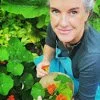
Tea with a Druid
A visit with Eimear Burke, Druid and Storyteller
In early February Kilkenny beckons, skeletal winter trees etched against the horizon, huge banks of clouds. Unfathomable mountains seem to loom behind this layered skyline but when the thick haze clears away, it reveals only rolling fields, thick with moisture. Hedgerows floating in sparse thickets between lakes of water. Two weeks previous to this I spent an hour on the phone with Eimear finding common ground in the small landlocked country of Lesotho as we had both, rather unusually, spent time there in the 1980s. Shortly after, I meet her in person at a storytelling weekend in Galway. I haven’t heard her telling in person but I am intrigued and not a little intimidated by her official title; chosen Chief of the Order of Bards, Ovates and Druids.
A small humped-back stone bridge and walls frame the flooded fields. A curve in the road swoops up to a driveway, beside a tiny graveyard, blanketed with bright moss. An old tower looms above it. This is the rectory where Eimear has lived on and off for decades with her husband Howard Campbell, and now alone, since his death. Motifs of hares and triskels are on her camper van and car. She greets me from a bright red wooden door and leads me down deep stone steps into a large conservatory flanked by small stone storehouses with more red doors adorned with Bridget’s crosses. There are herbs, and a grapevine in stark winter shrivel. We go up and up dark green wooden stairs into a capacious living room with a lit stove. Deep salmon-pink walls, large windows and walls full of goddess imagery-from felted figures, photographs, drawings, images of breasts and piles of books in corners. There is a sense of seasons, abundance, cycles, and age. It’s very quiet. It’s a privilege to be invited into this home and I am trying not to over-talk. Eimear pours us tea. It tastes of rosehips, is fragrant and herby.
I grew up with myths and legends of Ireland but a lot of the stories in the Bardic tradition are Welsh. I travel a lot, but the more I travel the deeper my roots are here… When you are walking in the landscape where the stories take place it animates them, and brings soul into the story… it’s tapping into the magic of the landscape. I find that fascinating. As a druid we walk with one foot in that world, and the other foot in the modern world, being able to walk in that liminal space between the two worlds and tapping into it.
Sometimes she finds certain designated sacred places have little appeal for her. Lough Gur comes up as a place she finds evocative and there is a sense of glee when she shares a story from there about the inadvisability of annoying older women.
Just like with people there is a sense of reciprocity with a place, just like you have people you get on with and others not so much, or preferences around food or music. It’s always about relationship and relationality….
We delve into childhood and she shares some of her childhood places. We talk about the vastly shrunken radius of childhood.
I come from rural Ireland, the bog, Offaly. It was a tiny village, we were totally unsupervised, tree climbing, a stream the River Brosna, seven miles from the Shannon, there was an old railway bridge where we would gather hazelnuts. I wouldn’t have allowed my own children to do that… I was off swimming in the silver river, there was a castle, a tower house, I would get through the window and climb up the walls, wild places. On my grandmother’s farm there were chickens, turkeys, we’d milk cows, I’d go off fishing with my cousin by the River Suck with a bamboo pole at a place called the Perch Hole.
At nine years of age she rode her pony twelve miles to her Grandmother’s house. Her father followed her two miles down the road to make sure she took the right turn. At the end of the summer her six-year-old brother rode the pony back. ‘No hat or anything. We’d have been taken into care now!’
Around her storytelling practice and journey.
I know the story before I write it. I tell it to myself, not as a short story writer though. I don’t go into long descriptions. When I tell a story, I hope I create a picture. I do it organically. I may make references to someone in the room, or reflect on something that another teller has mentioned or bring topical things in…... I am very visual and I can read a story through again and will remember it easily, and because I am not an actor I can go off piste because it’s my script… I like to be able to see the faces of my audience
I started originally telling jokes. I had no value of jokes as an art form, then I was at a Shamanic gathering and I started telling.
Supporting her practice methodology she has a trusted small group of friends.
I have written nine stories, as a teller, not a short story writer. I told three of them recently in Kilkenny accompanied by the harp… I have some psychology friends, one’s a novelist, but they are not tellers. I send them a story in advance, they read it, then I tell it to them, and we have a conversation about it…. I emphasise the importance of women in stories… some of them don’t even have a voice…but they are not helpless.
Our conversation is corner-stoned by some short lyrical stories that Eimear shares; it almost feels as though the stories have agency throughout. They are rhythmic and resonant and I get a taste of her style and passion around telling.
Stories are not just for entertainment, they can be entertaining but there’s something around there being a lesson in them somehow, a teaching, a resonance. People go into a story and find healing in it. I don’t say ‘This is a healing story’ but there is the Mish story that I tell, and I start off by saying that ‘This is a story of what can cause madness and what can heal madness’. You can tell the story in a humorous way, but you can also tell it to show the madness of grief and what it can do to you. In Druidry we talk about combining reverence with mirth.
We talk about paradigm shifts in healing and this dips into masculine and feminine narratives in storytelling.
I think it’s the same with so many things. There’s the notion of the hero, women feel left out, ‘well this is all about men, what about me?’ but you already have it within you and you discover it…You’ve been in your grandmothers womb and your mother has been in her grandmothers womb and back… lines of generations of wisdom… Do we need to have that Campbell model? (The Hero’s Journey concept) I don’t think so. We are so locked into this one way of thinking.
We touch on aging and how freeing it can be.
There’s this idea that you can’t be older and have long hair, you’ve ‘let yourself go’, that anyone with a bit of respectability doesn’t; they get their hair styled. Turning 40 was brilliant for me…once I turned 50 I found my wildness.
Eimear strikes me as someone who has forged a fine balance in her life. She has a pragmatic tolerance and appreciation of her diverse community and is also very happy to be solitary. Her daily practice is very linguistical with a variety of languages that she avidly absorbs. She is curious and constantly learning.
I lost my confidence in Irish. But then I started on Duolingo 10 years ago. They were twinning towns in Ireland on TG4 and Freshford was twinned with Cong. I was asked to do a Solstice ceremony as Gaeilge. They didn’t end up showing that footage, but it made me use the language. I took up Italian, I do it every day. Also French and Spanish. I’m now making links between the languages.
I never had a plan. I drifted into psychology, palliative care… Things come and go. It was never my intention to be a storyteller, to play the harp, none of these things were my intention... but opportunities arise and I’ve left myself open… You have to be grounded. With Druidry, the whole training is about being grounded. All the rituals are earth based. We have everything we need here on this land…When anyone goes off seeking they end up back at themselves. Of course you can’t tell people that;they need to find it out for themselves.
Eimear cultivates a web of connection and cultural links home and abroad. From traditional healers to other storytellers, she communicates with a colourful mosaic of people and much of this is rooted in her Druidic practice
When we (Howard and herself) started opening our Grove here, we started creating community through Druidry, my kids didn’t go to school here, they were home educated and I didn’t go to the local church. That’s how people meet… So it’s mostly through Druidry; I have local people come and then people travel, and all sorts of weirdos. So look, I have a respectable life. Howard was a doctor, none of our friends were doctors apart from those who were in college with him, I have some psychology friends, a few nursing friends and the rest are the weirdos, and now there are the storytellers.
I have never felt I belonged in Irish culture even though I belonged to the land. You know, GAA, Fianna Fail, The Rose of Tralee and I’m there on the edge.… If you are on the edge you can blend into a culture. I’ve worked in Kimmage multiculturally, Lesotho, Tanzania, Kenya and then with Druidry we have a global organisation. We have all faiths and none. We have Buddhists, Muslims, Jews, Christians, Animists, Atheists all coming together. Your Druidry is your path. There is no dogma. I’d say if you are looking for certainty you are on the wrong boat.
Our time is up. As a busy celebrant, she has a rehearsal this afternoon and a wedding on the morrow. She always tells a story at these celebrations and I’m sure they are lyrical, with some healing in there too. We bid farewell. Leaving her stronghold, and homeward bound I see a sign that proclaims: Jesus is the Way. From dusty red dirt roads under wide, African skies to mossy, secret lines in this Irish landscape, I think of all the diverse ways to a fulfilling life. The individual winding routes of our unique paths. Visiting Eimear has reminded me that there is vast beauty in every journey and there is great comfort in that.